Lecture 11: Partial Differential Equations (PDEs)#
Computational Physics — Spring 2026
Why PDEs?#
PDEs describe how quantities vary in both space and time:
Physics |
Equation |
Type |
|---|---|---|
Heat conduction |
\(\partial T/\partial t = \alpha \, \partial^2 T/\partial x^2\) |
Parabolic |
Wave propagation |
\(\partial^2 u/\partial t^2 = c^2 \, \partial^2 u/\partial x^2\) |
Hyperbolic |
Electrostatics |
\(\nabla^2 \phi = -\rho/\epsilon_0\) |
Elliptic |
Quantum mechanics |
\(i\hbar \, \partial\psi/\partial t = -(\hbar^2/2m) \, \partial^2\psi/\partial x^2 + V\psi\) |
Parabolic (in imaginary time) |
Fluid dynamics |
\(\partial \mathbf{v}/\partial t + (\mathbf{v}\cdot\nabla)\mathbf{v} = -\nabla p/\rho + \nu\nabla^2\mathbf{v}\) |
Mixed |
Strategy: Discretize space on a grid, replace derivatives with finite differences → system of ODEs or algebraic equations.
import numpy as np
import matplotlib.pyplot as plt
from matplotlib import animation
from scipy import sparse
from scipy.sparse.linalg import spsolve

# Projector-friendly settings
plt.rcParams['figure.figsize'] = [6, 4]
plt.rcParams['font.size'] = 9

print("Ready!")
Ready!
I. PDE Classification and Finite Differences#
Three Types of PDEs#
For a second-order linear PDE \(A u_{xx} + 2B u_{xt} + C u_{tt} = \ldots\) :
Type |
Discriminant |
Prototype |
Physics |
Boundary conditions |
|---|---|---|---|---|
Parabolic |
\(B^2 - AC = 0\) |
Heat equation |
Diffusion, relaxation |
Initial + boundary |
Hyperbolic |
\(B^2 - AC > 0\) |
Wave equation |
Waves, vibrations |
Initial + boundary |
Elliptic |
\(B^2 - AC < 0\) |
Laplace equation |
Steady state, equilibrium |
Boundary only |
Each type requires different numerical strategies!
Finite Difference Refresher#
From Lecture 05, we approximate derivatives on a grid with spacing \(\Delta x\):
For time derivatives with spacing \(\Delta t\):
Notation: \(u_i^n\) = value at grid point \(i\), time step \(n\).
II. The 1D Heat Equation (Parabolic PDE)#
The Physics#
A metal rod of length \(L\) with temperature \(T(x, t)\):
where \(\alpha\) is the thermal diffusivity (how fast heat spreads).
FTCS: Forward Time, Central Space#
Discretize: forward difference in time, central difference in space:
Solving for the future:
where \(r = \alpha \Delta t / \Delta x^2\) is the mesh ratio.
def heat_ftcs(T0, alpha, dx, dt, n_steps, bc_left=0.0, bc_right=0.0):
    """Solve the 1D heat equation using FTCS (Forward Time, Central Space).

    Parameters
    ----------
    T0 : ndarray
        Initial temperature profile (N_x points).
    alpha : float
        Thermal diffusivity.
    dx : float
        Spatial grid spacing.
    dt : float
        Time step.
    n_steps : int
        Number of time steps to take.
    bc_left, bc_right : float
        Dirichlet boundary conditions.

    Returns
    -------
    T_history : ndarray
        Temperature at each saved time step, shape (n_saved, N_x).
    """
    N_x = len(T0)
    r = alpha * dt / dx**2   # Mesh ratio

    T = T0.copy()
    save_every = max(1, n_steps // 100)
    T_history = [T.copy()]

    for n in range(n_steps):
        T_new = T.copy()

        # code here
        for i in range(1, N_x -1):
            T_new[i] = T[i] + r*(T[i+1] - 2*T[i] + T[i-1])

        # Apply boundary conditions
        T_new[0] = bc_left
        T_new[-1] = bc_right
        T = T_new
        if (n + 1) % save_every == 0:
            T_history.append(T.copy())

    return np.array(T_history)

# ---- Demo: Hot spot diffusing in a cold rod ----
L = 1.0          # Rod length (m)
N_x = 101        # Grid points
alpha = 0.01     # Thermal diffusivity (m^2/s)
dx = L / (N_x - 1)
x = np.linspace(0, L, N_x)

# Initial condition: Gaussian hot spot in the middle
T0 = np.exp(-((x - 0.5)**2) / (2 * 0.02**2))

# Stable time step (we'll explain why later!)
dt = 0.4 * dx**2 / alpha   # r = 0.4 < 0.5
n_steps = 5000

print(f"Grid spacing: dx = {dx:.4f}")
print(f"Time step:    dt = {dt:.6f}")
print(f"Mesh ratio:   r  = {alpha * dt / dx**2:.2f}")
print(f"Total time:   {n_steps * dt:.2f} s")

T_hist = heat_ftcs(T0, alpha, dx, dt, n_steps)

# Plot snapshots
fig, ax = plt.subplots(figsize=(6, 5))
n_snapshots = min(len(T_hist), 8)
colors = plt.cm.coolwarm(np.linspace(1, 0, n_snapshots))
times = np.linspace(0, n_steps * dt, len(T_hist))

snap_indices = np.linspace(0, len(T_hist)-1, n_snapshots, dtype=int)
for i, idx in enumerate(snap_indices):
    ax.plot(x, T_hist[idx], color=colors[i],
            linewidth=1, label=f't = {times[idx]:.2f} s')

ax.set_xlabel('Position x (m)')
ax.set_ylabel('Temperature T')
ax.set_title('Heat Equation: Gaussian Pulse Diffusing')
ax.legend(fontsize=6, ncol=2)
ax.grid(True, alpha=0.3)
plt.tight_layout()
plt.show()

print("The hot spot spreads out and flattens — diffusion in action!")
print(f"Conservation check: initial integral = {np.trapz(T0, x):.4f}, final = {np.trapz(T_hist[-1], x):.4f}")
Grid spacing: dx = 0.0100
Time step:    dt = 0.004000
Mesh ratio:   r  = 0.40
Total time:   20.00 s
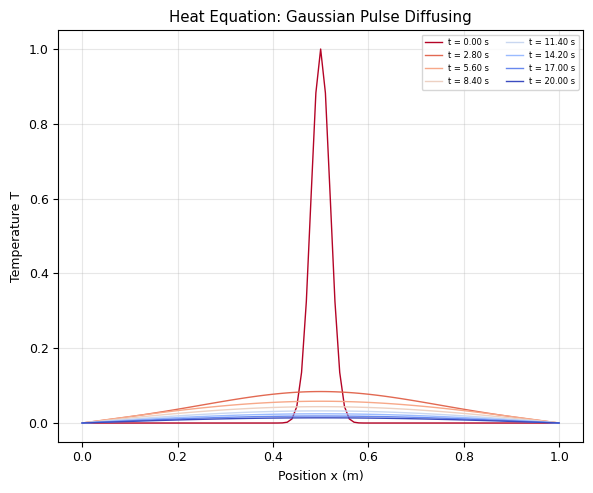
The hot spot spreads out and flattens — diffusion in action!
Conservation check: initial integral = 0.0501, final = 0.0088
/tmp/ipykernel_408/1936641005.py:88: DeprecationWarning: `trapz` is deprecated. Use `trapezoid` instead, or one of the numerical integration functions in `scipy.integrate`.
  print(f"Conservation check: initial integral = {np.trapz(T0, x):.4f}, final = {np.trapz(T_hist[-1], x):.4f}")
III. Stability: Why Your Simulation Can Explode#
The CFL Condition#
The FTCS scheme is conditionally stable. It only works when:
If \(r > 1/2\), small numerical errors grow exponentially and the solution blows up!
Von Neumann Stability Analysis#
Assume a perturbation \(\epsilon_i^n = A^n e^{ijk\Delta x}\). Substituting into the FTCS scheme:
For stability, \(|A| \leq 1\) for all \(k\) → the worst case is \(\sin^2 = 1\):
Physical interpretation: Information can’t travel faster than one grid cell per time step.
# Demonstrate instability: r > 0.5
fig, axes = plt.subplots(1, 3, figsize=(6, 4))

for idx, r_val in enumerate([0.25, 0.50, 0.55]):
    dt_test = r_val * dx**2 / alpha
    T_test = heat_ftcs(T0, alpha, dx, dt_test, n_steps=200)

    # Plot a few snapshots
    for snap_idx in [0, len(T_test)//4, len(T_test)//2, -1]:
        axes[idx].plot(x, T_test[snap_idx], linewidth=0.8)

    axes[idx].set_title(f'r = {r_val}', fontsize=8)
    axes[idx].set_xlabel('x', fontsize=7)
    axes[idx].set_ylim(-1.5, 1.5)
    axes[idx].grid(True, alpha=0.3)
    axes[idx].tick_params(labelsize=7)

axes[0].set_ylabel('T')
plt.suptitle('FTCS Stability: Mesh Ratio r', fontsize=9)
plt.tight_layout()
plt.show()

print("r = 0.25: Stable and smooth — diffusion works correctly")
print("r = 0.50: Right at the stability limit — oscillations may appear")
print("r = 0.55: UNSTABLE — oscillations grow exponentially!")
print("This is the CFL condition: Δt ≤ Δx²/(2α)")
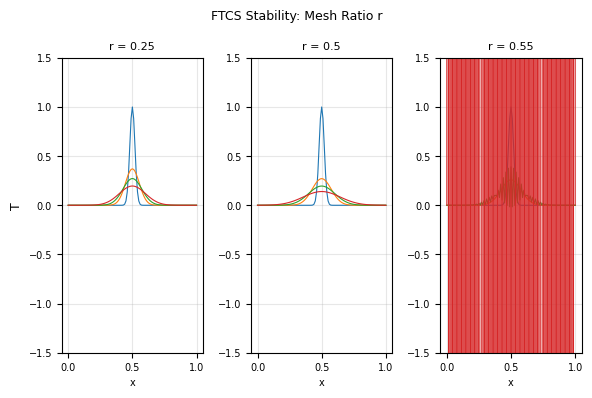
r = 0.25: Stable and smooth — diffusion works correctly
r = 0.50: Right at the stability limit — oscillations may appear
r = 0.55: UNSTABLE — oscillations grow exponentially!
This is the CFL condition: Δt ≤ Δx²/(2α)
V. The 1D Wave Equation (Hyperbolic PDE)#
The Physics#
A vibrating string, sound wave, or electromagnetic wave:
Unlike diffusion, waves propagate without spreading — information travels at speed \(c\).
CTCS: Central Time, Central Space#
Use central differences in both time and space:
Solving for the future:
where \(s = c \Delta t / \Delta x\) is the Courant number.
Stability (CFL Condition for Waves)#
The numerical wave speed must not exceed the physical wave speed.
def wave_ctcs(u0, v0, c, dx, dt, n_steps, bc='fixed'):
    """Solve the 1D wave equation using CTCS (leapfrog) method.

    Parameters
    ----------
    u0 : ndarray
        Initial displacement.
    v0 : ndarray
        Initial velocity.
    c : float
        Wave speed.
    dx, dt : float
        Grid spacing and time step.
    n_steps : int
        Number of time steps.
    bc : str
        'fixed' (Dirichlet u=0) or 'free' (Neumann du/dx=0).

    Returns
    -------
    u_history : ndarray
        Displacement snapshots.
    """
    N = len(u0)
    s = c * dt / dx      # Courant number
    s2 = s**2

    u_prev = u0.copy()
    # First step using initial velocity: u^1 = u^0 + dt*v0 + 0.5*s2*(u_{i+1}-2u_i+u_{i-1})
    u_curr = u0.copy()
    for i in range(1, N-1):
        u_curr[i] = (u0[i] + dt * v0[i]
                     + 0.5 * s2 * (u0[i+1] - 2*u0[i] + u0[i-1]))

    save_every = max(1, n_steps // 200)
    u_history = [u0.copy()]

    for n in range(1, n_steps):
        u_next = np.zeros(N)
        for i in range(1, N-1):
            # u_next[i] =
            u_next[i] = 2*u_curr[i]-u_prev[i] + s2 * (u_curr[i+1] - 2*u_curr[i] + u_curr[i-1])

        # Boundary conditions
        if bc == 'fixed':
            u_next[0] = 0.0
            u_next[-1] = 0.0
        elif bc == 'free':
            u_next[0] = u_next[1]
            u_next[-1] = u_next[-2]

        u_prev = u_curr.copy()
        u_curr = u_next.copy()

        if n % save_every == 0:
            u_history.append(u_curr.copy())

    return np.array(u_history)

# ---- Demo: Plucked string ----
L = 1.0
N_x = 201
c = 1.0        # Wave speed
dx = L / (N_x - 1)
x = np.linspace(0, L, N_x)

# Initial condition: plucked string (triangle)
u0 = np.where(x < 0.3, x / 0.3 * 0.5, 0.5 * (1 - x) / 0.7)
u0[0] = 0; u0[-1] = 0   # Fixed endpoints
v0 = np.zeros(N_x)       # Released from rest

# Stable time step
dt = 0.8 * dx / c  # Courant number = 0.8
n_steps = 2000

print(f"Courant number: s = c*dt/dx = {c * dt / dx:.2f}")
print(f"Total simulation time: {n_steps * dt:.2f} s")

u_hist = wave_ctcs(u0, v0, c, dx, dt, n_steps, bc='fixed')

# Plot snapshots
fig, ax = plt.subplots(figsize=(6, 5))
n_show = 8
colors = plt.cm.viridis(np.linspace(0, 1, n_show))

for idx, snap in enumerate(np.linspace(0, len(u_hist)-1, n_show, dtype=int)):
    t_val = snap * (n_steps / len(u_hist)) * dt
    ax.plot(x, u_hist[snap], color=colors[idx], linewidth=1,
            label=f't = {t_val:.2f}')

ax.set_xlabel('Position x')
ax.set_ylabel('Displacement u')
ax.set_title('Vibrating String (Fixed Endpoints)')
ax.legend(fontsize=6, ncol=2)
ax.grid(True, alpha=0.3)
plt.tight_layout()
plt.show()

print("The plucked string vibrates — standing waves form!")
print("Fixed endpoints → only certain wavelengths are allowed (harmonics)")
Courant number: s = c*dt/dx = 0.80
Total simulation time: 8.00 s
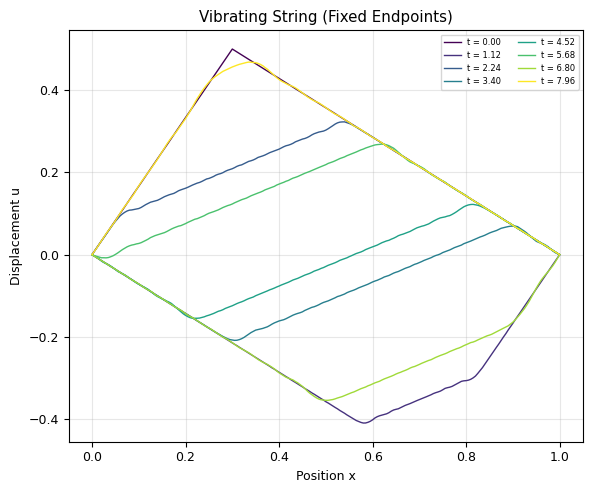
The plucked string vibrates — standing waves form!
Fixed endpoints → only certain wavelengths are allowed (harmonics)
Wave Packet Propagation#
Let’s watch a Gaussian wave packet travel, reflect off boundaries, and interfere with itself.
# Wave packet: Gaussian envelope * carrier wave
sigma = 0.05
x0_wave = 0.2
k0 = 40.0  # carrier wavevector

u0_packet = np.exp(-((x - x0_wave)**2) / (2*sigma**2)) * np.sin(k0 * x)
u0_packet[0] = 0; u0_packet[-1] = 0
v0_packet = np.zeros(N_x)

dt_wp = 0.9 * dx / c
u_wp = wave_ctcs(u0_packet, v0_packet, c, dx, dt_wp, n_steps=4000, bc='fixed')

# Waterfall plot
fig, ax = plt.subplots(figsize=(6, 6))
n_traces = 30
for idx, snap in enumerate(np.linspace(0, len(u_wp)-1, n_traces, dtype=int)):
    offset = idx * 0.15
    ax.plot(x, u_wp[snap] + offset, 'b-', linewidth=0.5, alpha=0.7)
    ax.fill_between(x, offset, u_wp[snap] + offset, alpha=0.05, color='blue')

ax.set_xlabel('Position x')
ax.set_ylabel('Time →')
ax.set_title('Wave Packet: Propagation & Reflection')
ax.set_yticks([])
plt.tight_layout()
plt.show()

print("The wave packet travels right, reflects off the fixed end (inverted!),")
print("travels left, reflects again, and keeps bouncing.")
print("Fixed boundary: reflection with sign flip (node at boundary)")
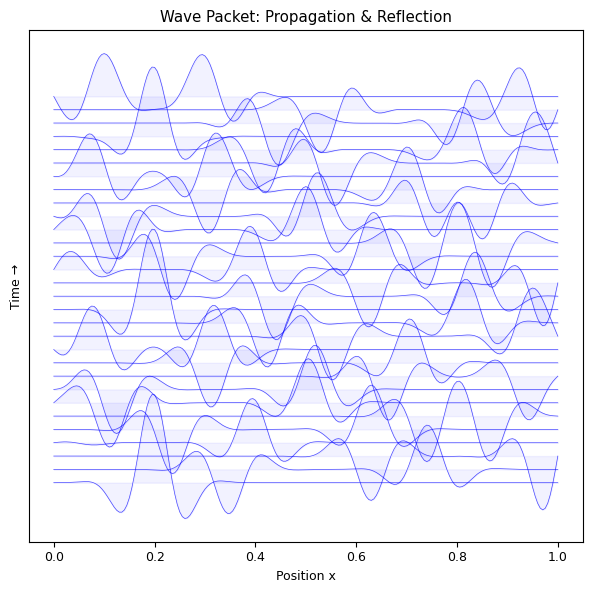
The wave packet travels right, reflects off the fixed end (inverted!),
travels left, reflects again, and keeps bouncing.
Fixed boundary: reflection with sign flip (node at boundary)
VI. The 2D Laplace Equation (Elliptic PDE)#
The Physics#
In electrostatics, the potential \(\phi\) in a charge-free region satisfies:
No time variable! This is a boundary value problem — the solution everywhere is determined by the boundary conditions.
Jacobi Relaxation Method#
Discretize on a 2D grid. At each interior point:
For \(\Delta x = \Delta y\), solve for \(\phi_{i,j}\):
Each point is the average of its four neighbors! Iterate until convergence:
Initialize with a guess
Update every interior point with the 4-neighbor average
Check if the solution has changed
Repeat until changes are smaller than tolerance
def laplace_jacobi(phi0, bc_mask, max_iter=10000, tol=1e-5):
    """Solve 2D Laplace equation using Jacobi relaxation.

    Parameters
    ----------
    phi0 : ndarray (Ny, Nx)
        Initial guess (including boundary values).
    bc_mask : ndarray of bool (Ny, Nx)
        True where values are fixed (boundary conditions).
    max_iter : int
        Maximum iterations.
    tol : float
        Convergence tolerance (max change per iteration).

    Returns
    -------
    phi : ndarray
        Converged solution.
    residuals : list
        Max residual at each iteration.
    """
    phi = phi0.copy()
    residuals = []

    for iteration in range(max_iter):
        phi_old = phi.copy()

        ## N = len(phi)
        ## for i in range (1, N-1):
        ##.   for j in range (1, N-1):
        ##         phi[i,j] = (phi_old[i-1,j] + phi_old[i+1,j] + phi_old[i,j-1] + phi_old[i,j+1])/4

        # Update interior points: average of 4 neighbors
        phi[1:-1, 1:-1] = 0.25 * (
            phi_old[2:, 1:-1] + phi_old[:-2, 1:-1] +   # up + down
            phi_old[1:-1, 2:] + phi_old[1:-1, :-2]       # right + left
        )

        # Restore boundary conditions
        phi[bc_mask] = phi0[bc_mask]

        # Check convergence
        max_change = np.max(np.abs(phi - phi_old))
        residuals.append(max_change)

        if max_change < tol:
            print(f"Converged in {iteration+1} iterations (max change = {max_change:.2e})")
            break
    else:
        print(f"Warning: did not converge after {max_iter} iterations (max change = {max_change:.2e})")

    return phi, residuals

# ---- Parallel plate capacitor ----
Nx, Ny = 61, 61
phi0 = np.zeros((Ny, Nx))
bc_mask = np.zeros((Ny, Nx), dtype=bool)

# Top plate at y = 0.8, x from 0.2 to 0.8: V = +100
# Bottom plate at y = 0.2, x from 0.2 to 0.8: V = -100
plate_y_top = int(0.8 * (Ny - 1))
plate_y_bot = int(0.2 * (Ny - 1))
plate_x_start = int(0.2 * (Nx - 1))
plate_x_end = int(0.8 * (Nx - 1))

phi0[plate_y_top, plate_x_start:plate_x_end+1] = +100
phi0[plate_y_bot, plate_x_start:plate_x_end+1] = -100
bc_mask[plate_y_top, plate_x_start:plate_x_end+1] = True
bc_mask[plate_y_bot, plate_x_start:plate_x_end+1] = True

# Boundary: walls at V=0
bc_mask[0, :] = True; bc_mask[-1, :] = True
bc_mask[:, 0] = True; bc_mask[:, -1] = True

phi, residuals = laplace_jacobi(phi0, bc_mask, max_iter=20000, tol=1e-6)

# Plot
x_grid = np.linspace(0, 1, Nx)
y_grid = np.linspace(0, 1, Ny)
X, Y = np.meshgrid(x_grid, y_grid)

fig, (ax1, ax2) = plt.subplots(1, 2, figsize=(6, 4))

# Potential contour
cp = ax1.contourf(X, Y, phi, levels=30, cmap='RdBu_r')
ax1.contour(X, Y, phi, levels=15, colors='k', linewidths=0.3)
plt.colorbar(cp, ax=ax1, label='Potential φ (V)')
ax1.set_xlabel('x')
ax1.set_ylabel('y')
ax1.set_title('Electric Potential', fontsize=8)
ax1.set_aspect('equal')

# Electric field (negative gradient of potential)
Ey, Ex = np.gradient(-phi, y_grid, x_grid)
skip = 3
ax2.quiver(X[::skip, ::skip], Y[::skip, ::skip],
           Ex[::skip, ::skip], Ey[::skip, ::skip],
           color='steelblue', scale=2000, width=0.003)
ax2.set_xlabel('x')
ax2.set_ylabel('y')
ax2.set_title('Electric Field E = -∇φ', fontsize=8)
ax2.set_aspect('equal')

plt.suptitle('Parallel Plate Capacitor (Laplace Equation)', fontsize=9)
plt.tight_layout()
plt.show()

print("Between the plates: nearly uniform field (as expected)")
print("Fringe fields visible at the plate edges")
Converged in 1636 iterations (max change = 9.99e-07)
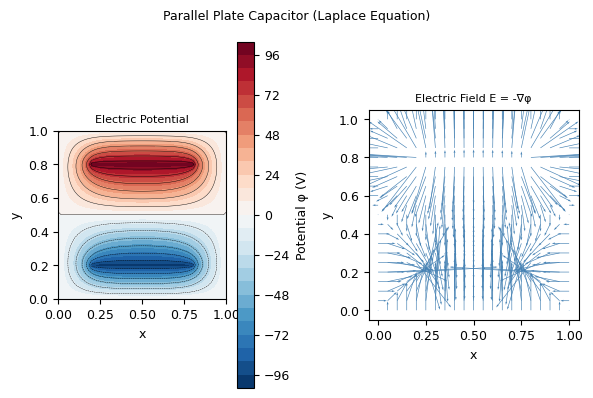
Between the plates: nearly uniform field (as expected)
Fringe fields visible at the plate edges
Convergence of Jacobi Iteration#
fig, ax = plt.subplots(figsize=(6, 4))
ax.semilogy(residuals, 'b-', linewidth=0.8)
ax.set_xlabel('Iteration')
ax.set_ylabel('Max change between iterations')
ax.set_title('Jacobi Relaxation Convergence')
ax.axhline(1e-6, color='r', linestyle='--', label='Tolerance = 10⁻⁶')
ax.legend(fontsize=7)
ax.grid(True, alpha=0.3)
plt.tight_layout()
plt.show()

print(f"Jacobi converged in {len(residuals)} iterations.")
print("Gauss-Seidel and SOR (Successive Over-Relaxation) converge faster.")
print("For large problems, multigrid methods are much more efficient.")
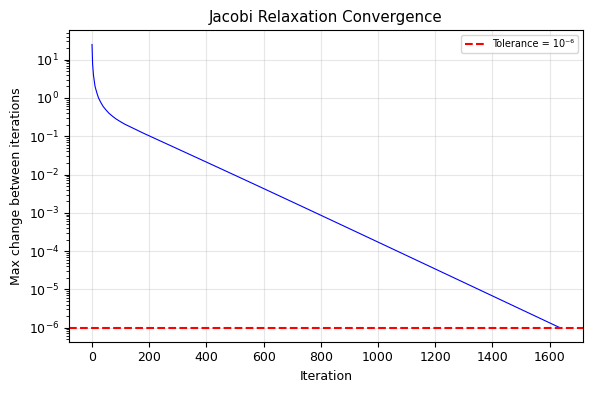
Jacobi converged in 1636 iterations.
Gauss-Seidel and SOR (Successive Over-Relaxation) converge faster.
For large problems, multigrid methods are much more efficient.
VII. Faster Solvers: Gauss-Seidel and SOR#
Gauss-Seidel#
Same as Jacobi, but use updated values immediately as they become available (just like Euler-Cromer!):
When computing \(\phi_{i,j}\), use the already-updated \(\phi_{i-1,j}\) and \(\phi_{i,j-1}\) from this iteration.
SOR (Successive Over-Relaxation)#
Take the Gauss-Seidel update and overshoot:
where \(\omega\) is the relaxation parameter:
\(\omega = 1\): Gauss-Seidel
\(1 < \omega < 2\): Over-relaxation (faster convergence)
\(\omega \geq 2\): Unstable!
Optimal \(\omega\) for an \(N \times N\) grid: \(\omega_{\text{opt}} \approx 2 - \frac{2\pi}{N}\)
def laplace_sor(phi0, bc_mask, omega=1.5, max_iter=10000, tol=1e-5):
    """Solve 2D Laplace equation using SOR (Successive Over-Relaxation).

    Parameters
    ----------
    phi0 : ndarray (Ny, Nx)
        Initial guess (including boundary values).
    bc_mask : ndarray of bool
        True where values are fixed.
    omega : float
        Relaxation parameter (1 = Gauss-Seidel, 1 < omega < 2 = SOR).
    max_iter : int
        Maximum iterations.
    tol : float
        Convergence tolerance.

    Returns
    -------
    phi : ndarray
        Converged solution.
    residuals : list
        Max residual at each iteration.
    """
    phi = phi0.copy()
    Ny, Nx = phi.shape
    residuals = []

    for iteration in range(max_iter):
        max_change = 0.0

        for i in range(1, Ny-1):
            for j in range(1, Nx-1):
                if bc_mask[i, j]:
                    continue

                # Gauss-Seidel update (uses already-updated neighbors)
                phi_gs = 0.25 * (phi[i+1, j] + phi[i-1, j] +
                                  phi[i, j+1] + phi[i, j-1])

                # SOR: blend old and Gauss-Seidel
                phi_new = (1 - omega) * phi[i, j] + omega * phi_gs

                change = abs(phi_new - phi[i, j])
                if change > max_change:
                    max_change = change
                phi[i, j] = phi_new

        residuals.append(max_change)
        if max_change < tol:
            break

    return phi, residuals

# Compare Jacobi vs Gauss-Seidel vs SOR
omega_opt = 2 - 2*np.pi / Nx  # Optimal relaxation parameter

print(f"Grid size: {Nx}x{Ny}")
print(f"Optimal ω ≈ {omega_opt:.3f}")
print()

_, res_jacobi = laplace_jacobi(phi0, bc_mask, max_iter=20000, tol=1e-6)
_, res_gs = laplace_sor(phi0, bc_mask, omega=1.0, max_iter=20000, tol=1e-6)
_, res_sor = laplace_sor(phi0, bc_mask, omega=omega_opt, max_iter=20000, tol=1e-6)

fig, ax = plt.subplots(figsize=(6, 4))
ax.semilogy(res_jacobi, 'r-', linewidth=0.8, label=f'Jacobi ({len(res_jacobi)} iter)')
ax.semilogy(res_gs, 'b-', linewidth=0.8, label=f'Gauss-Seidel ({len(res_gs)} iter)')
ax.semilogy(res_sor, 'g-', linewidth=0.8, label=f'SOR ω={omega_opt:.2f} ({len(res_sor)} iter)')
ax.axhline(1e-6, color='k', linestyle='--', alpha=0.5)
ax.set_xlabel('Iteration')
ax.set_ylabel('Max change')
ax.set_title('Convergence: Jacobi vs Gauss-Seidel vs SOR')
ax.legend(fontsize=7)
ax.grid(True, alpha=0.3)
plt.tight_layout()
plt.show()

print(f"Jacobi:       {len(res_jacobi)} iterations")
print(f"Gauss-Seidel: {len(res_gs)} iterations ({len(res_jacobi)/len(res_gs):.1f}x faster)")
print(f"SOR:          {len(res_sor)} iterations ({len(res_jacobi)/len(res_sor):.1f}x faster)")
Grid size: 61x61
Optimal ω ≈ 1.897

Converged in 1636 iterations (max change = 9.99e-07)
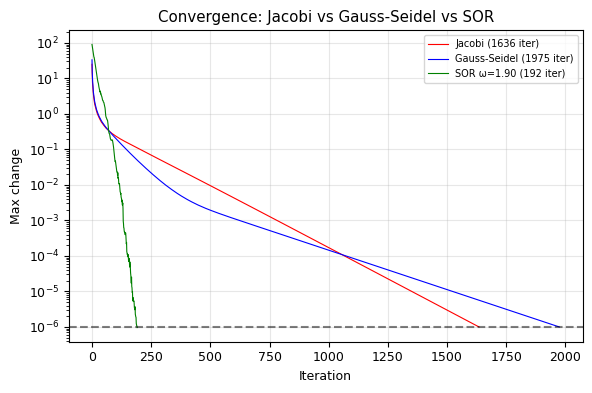
Jacobi:       1636 iterations
Gauss-Seidel: 1975 iterations (0.8x faster)
SOR:          192 iterations (8.5x faster)
VIII. Physics Application: Poisson Equation (Charges!)#
The Poisson equation includes a source term:
This describes the electric potential from a charge distribution \(\rho(x, y)\).
We modify the Jacobi update:
def poisson_jacobi(phi0, rho, bc_mask, dx, epsilon_0=1.0, max_iter=20000, tol=1e-5):
    """Solve 2D Poisson equation using Jacobi iteration.

    ∇²φ = -ρ/ε₀
    """
    phi = phi0.copy()
    source = (dx**2 / (4 * epsilon_0)) * rho
    residuals = []

    for iteration in range(max_iter):
        phi_old = phi.copy()
        phi[1:-1, 1:-1] = 0.25 * (
            phi_old[2:, 1:-1] + phi_old[:-2, 1:-1] +
            phi_old[1:-1, 2:] + phi_old[1:-1, :-2]
        ) + source[1:-1, 1:-1]

        phi[bc_mask] = phi0[bc_mask]

        max_change = np.max(np.abs(phi - phi_old))
        residuals.append(max_change)
        if max_change < tol:
            print(f"Converged in {iteration+1} iterations")
            break

    return phi, residuals

# ---- Electric dipole ----
Nx2, Ny2 = 81, 81
dx2 = 1.0 / (Nx2 - 1)
x2 = np.linspace(0, 1, Nx2)
y2 = np.linspace(0, 1, Ny2)
X2, Y2 = np.meshgrid(x2, y2)

# Charge distribution: +Q and -Q
rho = np.zeros((Ny2, Nx2))
# Positive charge at (0.35, 0.5)
q_plus_j = int(0.35 * (Nx2 - 1))
q_plus_i = int(0.5 * (Ny2 - 1))
rho[q_plus_i, q_plus_j] = +1000 / dx2**2

# Negative charge at (0.65, 0.5)
q_minus_j = int(0.65 * (Nx2 - 1))
q_minus_i = int(0.5 * (Ny2 - 1))
rho[q_minus_i, q_minus_j] = -1000 / dx2**2

# Boundary: grounded box (φ = 0)
phi0_poisson = np.zeros((Ny2, Nx2))
bc_mask2 = np.zeros((Ny2, Nx2), dtype=bool)
bc_mask2[0, :] = True; bc_mask2[-1, :] = True
bc_mask2[:, 0] = True; bc_mask2[:, -1] = True

phi_dipole, _ = poisson_jacobi(phi0_poisson, rho, bc_mask2, dx2, max_iter=30000, tol=1e-5)

# Plot
fig, (ax1, ax2) = plt.subplots(1, 2, figsize=(6, 4))

# Potential
levels = np.linspace(-50, 50, 31)
cp = ax1.contourf(X2, Y2, phi_dipole, levels=levels, cmap='RdBu_r', extend='both')
ax1.contour(X2, Y2, phi_dipole, levels=levels[::2], colors='k', linewidths=0.2)
plt.colorbar(cp, ax=ax1, label='φ')
ax1.plot(x2[q_plus_j], y2[q_plus_i], 'r+', markersize=12, markeredgewidth=2)
ax1.plot(x2[q_minus_j], y2[q_minus_i], 'b_', markersize=12, markeredgewidth=2)
ax1.set_title('Potential (dipole)', fontsize=8)
ax1.set_aspect('equal')
ax1.set_xlabel('x'); ax1.set_ylabel('y')

# Electric field
Ey2, Ex2 = np.gradient(-phi_dipole, y2, x2)
E_mag = np.sqrt(Ex2**2 + Ey2**2)
skip2 = 4
ax2.streamplot(X2, Y2, Ex2, Ey2, color=np.log10(E_mag + 1),
               cmap='hot', density=1.5, linewidth=0.5, arrowsize=0.5)
ax2.plot(x2[q_plus_j], y2[q_plus_i], 'r+', markersize=12, markeredgewidth=2, label='+Q')
ax2.plot(x2[q_minus_j], y2[q_minus_i], 'b_', markersize=12, markeredgewidth=2, label='-Q')
ax2.set_title('Electric Field Lines', fontsize=8)
ax2.set_aspect('equal')
ax2.set_xlabel('x'); ax2.set_ylabel('y')
ax2.legend(fontsize=7)

plt.suptitle('Poisson Equation: Electric Dipole', fontsize=9)
plt.tight_layout()
plt.show()

print("Field lines go from + to - charge")
print("Equipotential lines (contours) are perpendicular to field lines")
print("Far from the dipole: field falls off as 1/r³")
Converged in 5617 iterations
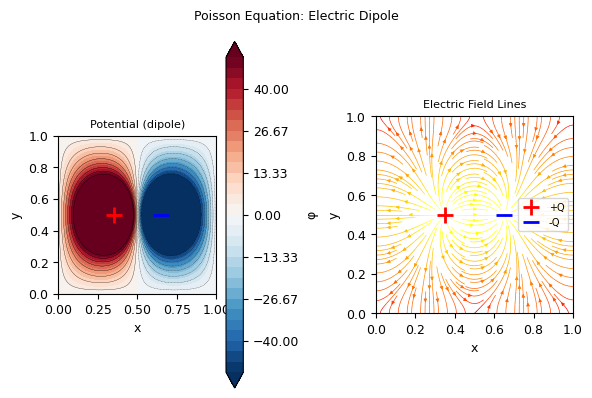
Field lines go from + to - charge
Equipotential lines (contours) are perpendicular to field lines
Far from the dipole: field falls off as 1/r³
IX. Physics Application: 2D Heat Equation#
Combining spatial dimensions:
FTCS in 2D:
Stability requires: \(r_x + r_y \leq 1/2\) where \(r_x = \alpha\Delta t/\Delta x^2\), \(r_y = \alpha\Delta t/\Delta y^2\).
# 2D heat equation: hot square cooling into cold plate
Nx3 = 51
Ny3 = 51
alpha_2d = 0.01
dx3 = 1.0 / (Nx3 - 1)
dy3 = 1.0 / (Ny3 - 1)
x3 = np.linspace(0, 1, Nx3)
y3 = np.linspace(0, 1, Ny3)
X3, Y3 = np.meshgrid(x3, y3)

# Initial condition: hot square in center
T2d = np.zeros((Ny3, Nx3))
hot_region = (X3 > 0.3) & (X3 < 0.7) & (Y3 > 0.3) & (Y3 < 0.7)
T2d[hot_region] = 100.0

# Stable time step
dt3 = 0.2 * dx3**2 / alpha_2d  # conservative for 2D
rx = alpha_2d * dt3 / dx3**2
ry = alpha_2d * dt3 / dy3**2
print(f"rx + ry = {rx + ry:.3f} (must be ≤ 0.5)")

# Time-stepping
n_steps_2d = 3000
snapshots = []
snap_times = []

T = T2d.copy()
for n in range(n_steps_2d):
    T_new = T.copy()
    T_new[1:-1, 1:-1] = T[1:-1, 1:-1] + (
        rx * (T[2:, 1:-1] - 2*T[1:-1, 1:-1] + T[:-2, 1:-1]) +
        ry * (T[1:-1, 2:] - 2*T[1:-1, 1:-1] + T[1:-1, :-2])
    )
    # Dirichlet BC: T = 0 on all boundaries
    T_new[0, :] = 0; T_new[-1, :] = 0
    T_new[:, 0] = 0; T_new[:, -1] = 0
    T = T_new

    if n in [0, 50, 200, 500, 1500, n_steps_2d-1]:
        snapshots.append(T.copy())
        snap_times.append(n * dt3)

# Plot
fig, axes = plt.subplots(2, 3, figsize=(6, 5))
axes = axes.flatten()

for idx, (snap, t_val) in enumerate(zip(snapshots, snap_times)):
    im = axes[idx].contourf(X3, Y3, snap, levels=20, cmap='hot', vmin=0, vmax=100)
    axes[idx].set_title(f't = {t_val:.3f}', fontsize=7)
    axes[idx].set_aspect('equal')
    axes[idx].tick_params(labelsize=6)
    if idx % 3 == 0:
        axes[idx].set_ylabel('y', fontsize=7)
    if idx >= 3:
        axes[idx].set_xlabel('x', fontsize=7)

plt.suptitle('2D Heat Equation: Hot Square Cooling', fontsize=9)
plt.tight_layout()
plt.show()

print("The sharp edges smooth out first (high curvature → fast diffusion)")
print("Eventually the temperature decays to zero everywhere")
print(f"Total heat: initial = {np.sum(T2d)*dx3*dy3:.2f}, final = {np.sum(snapshots[-1])*dx3*dy3:.2f}")
rx + ry = 0.400 (must be ≤ 0.5)
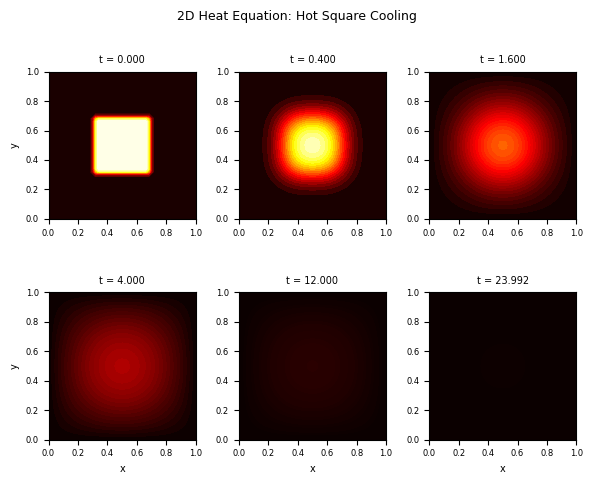
The sharp edges smooth out first (high curvature → fast diffusion)
Eventually the temperature decays to zero everywhere
Total heat: initial = 14.44, final = 0.18
X. Solving PDEs with FFT: Spectral Methods#
All the methods above use finite differences — local approximations to derivatives. There’s a completely different approach that uses the FFT from Lecture 09.
The Key Insight: Derivatives Become Multiplication#
Recall from Fourier analysis that the Fourier transform turns derivatives into algebraic operations:
where \(k\) is the wavenumber and \(\hat{f}(k)\) is the Fourier transform of \(f(x)\).
This means we can compute spatial derivatives exactly (to machine precision!) by:
FFT the function: \(f(x) \to \hat{f}(k)\)
Multiply by \(-k^2\): \(\hat{f}(k) \to -k^2\,\hat{f}(k)\)
Inverse FFT: \(-k^2\,\hat{f}(k) \to f''(x)\)
No finite difference approximation needed!
Application to the Heat Equation#
Take the heat equation \(\partial T/\partial t = \alpha \, \partial^2 T/\partial x^2\) and Fourier-transform in space:
This is now an ODE for each wavenumber \(k\) — and it has an exact solution:
Algorithm (analytical spectral method):
FFT the initial condition: \(T(x,0) \to \hat{T}(k,0)\)
Multiply each mode by the decay factor: \(\hat{T}(k,0) \cdot e^{-\alpha k^2 t}\)
Inverse FFT to get \(T(x, t)\)
No time stepping at all! We jump directly to any future time.
Why Spectral Methods Are Special#
Property |
Finite Difference |
Spectral (FFT) |
|---|---|---|
Spatial accuracy |
\(O(\Delta x^2)\) |
Exponential (machine precision for smooth functions) |
Stability limit |
CFL: \(r \leq 1/2\) |
None (analytical solution) |
Boundary conditions |
Any (Dirichlet, Neumann, …) |
Periodic only (limitation!) |
Cost per step |
\(O(N)\) |
\(O(N \log N)\) |
Best for |
General geometries, non-periodic BC |
Smooth periodic problems, turbulence |
Limitation: The standard FFT assumes periodic boundary conditions. For non-periodic problems, you need basis functions other than \(e^{ikx}\) — e.g., Chebyshev polynomials (Chebyshev spectral methods).
Spectral Time-Stepping (for more general PDEs)#
When you can’t solve analytically (e.g., nonlinear PDEs), use the FFT just for spatial derivatives:
Compute \(\partial^2 T/\partial x^2\) spectrally:
FFT → multiply by -k² → IFFTTime-step with any ODE method (Euler, RK4, etc.)
This gives spectral accuracy in space with your choice of time integrator.
# ---- Spectral Method for the Heat Equation ----
# Compare: FTCS (finite difference) vs Spectral (FFT)

# Setup: periodic domain [0, L) with Gaussian initial condition
L_sp = 2.0
N_sp = 128          # Grid points (power of 2 for FFT efficiency)
alpha_sp = 0.01     # Thermal diffusivity
dx_sp = L_sp / N_sp
x_sp = np.linspace(0, L_sp, N_sp, endpoint=False)  # Periodic: no repeated endpoint

# Initial condition: Gaussian (periodic-compatible)
T0_sp = np.exp(-((x_sp - 1.0)**2) / (2 * 0.05**2))

# ---- Method 1: Analytical spectral solution ----
# Wavenumbers for FFT (numpy convention)
k = 2 * np.pi * np.fft.fftfreq(N_sp, d=dx_sp)

# FFT of initial condition
T0_hat = np.fft.fft(T0_sp)

# Solve at multiple times — NO time stepping needed!
t_targets = [0, 0.5, 1.0, 2.0, 5.0]

fig, (ax1, ax2) = plt.subplots(1, 2, figsize=(6, 4))

colors_sp = plt.cm.coolwarm(np.linspace(1, 0, len(t_targets)))
for idx, t_val in enumerate(t_targets):
    # Exact spectral solution: multiply each mode by exp(-α k² t)
    decay = np.exp(-alpha_sp * k**2 * t_val)
    T_hat_t = T0_hat * decay
    T_spectral = np.real(np.fft.ifft(T_hat_t))
    ax1.plot(x_sp, T_spectral, color=colors_sp[idx], linewidth=1,
             label=f't = {t_val}')

ax1.set_xlabel('x')
ax1.set_ylabel('T')
ax1.set_title('Spectral Method (exact!)', fontsize=8)
ax1.legend(fontsize=6)
ax1.grid(True, alpha=0.3)

# ---- Show the decay of Fourier modes ----
k_pos = k[:N_sp//2]
for t_val in [0, 0.5, 2.0, 5.0]:
    decay = np.exp(-alpha_sp * k_pos**2 * t_val)
    ax2.plot(k_pos, decay, linewidth=1, label=f't = {t_val}')

ax2.set_xlabel('Wavenumber k')
ax2.set_ylabel('Decay factor $e^{-\\alpha k^2 t}$')
ax2.set_title('High-k modes decay fastest', fontsize=8)
ax2.legend(fontsize=6)
ax2.grid(True, alpha=0.3)

plt.suptitle('FFT Spectral Method: Heat Equation', fontsize=9)
plt.tight_layout()
plt.show()

print("Spectral method: NO time stepping, NO stability limit!")
print("We jump directly to any time t by multiplying Fourier modes by exp(-αk²t).")
print("High-frequency modes (large k) decay fastest — that's why diffusion smooths things out.")
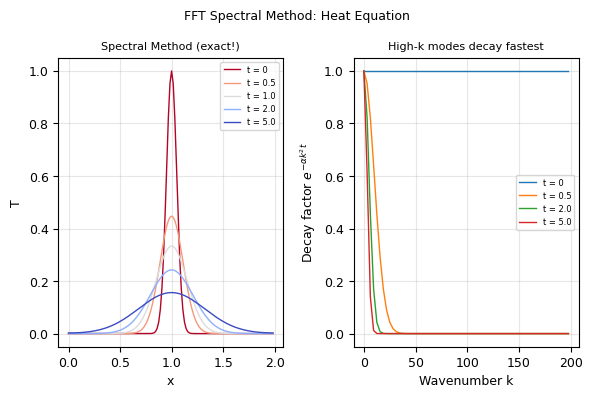
Spectral method: NO time stepping, NO stability limit!
We jump directly to any time t by multiplying Fourier modes by exp(-αk²t).
High-frequency modes (large k) decay fastest — that's why diffusion smooths things out.